What’s in the blog?
AI is everywhere right now. It’s transforming almost every sector. But when it comes to healthcare, the conversation feels different.
Within the MoneyAnna team, it’s one discussion that refuses to settle.
The conversation about ‘AI in healthcare’ started with the positives—faster diagnosis, better outcomes, and more precise treatments. And rightly so. But as the discussion intensified, a more uncomfortable question started emerging:
If healthcare is getting better… why does it feel like planning for it is becoming harder?
This question sat at the intersection of two very different lenses.
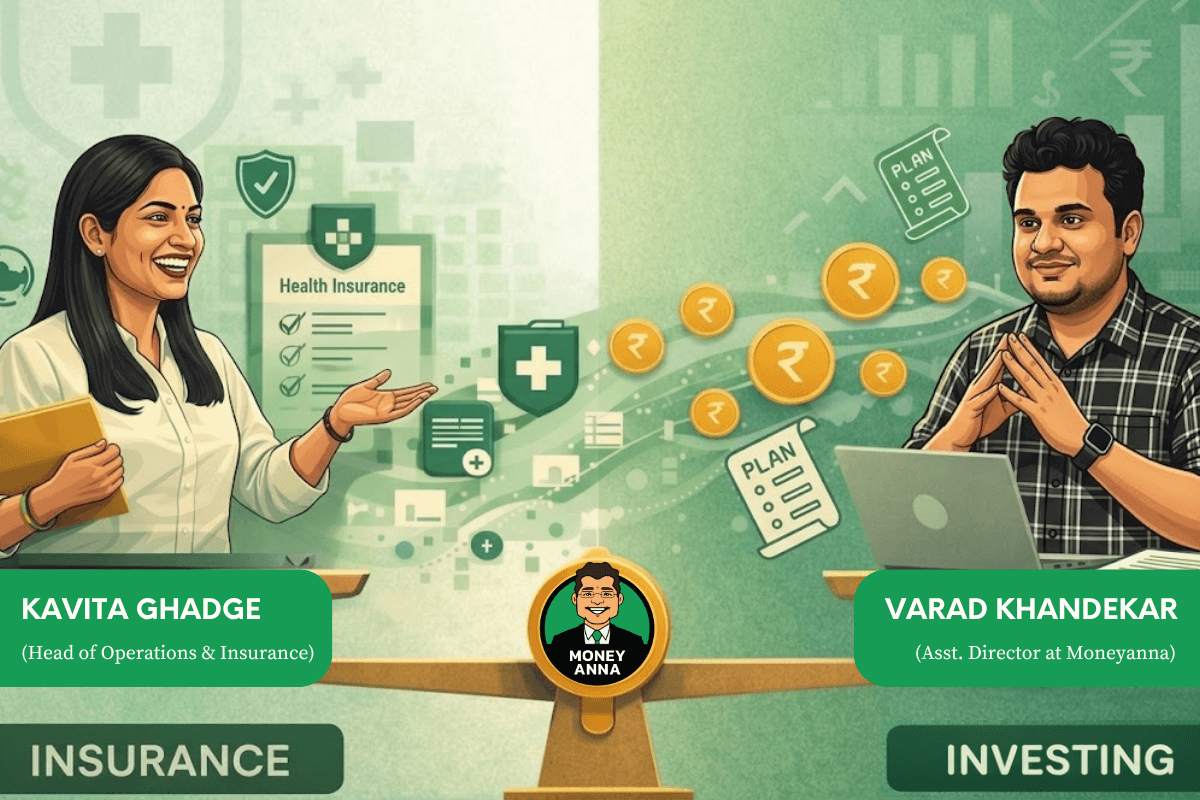
On one side was Kavita, who works closely with health insurance—reviewing policies, understanding claims behaviour, and seeing how healthcare costs actually play out in real situations.
On the other was Varad, who looks at portfolio management—thinking in terms of long-term risk, capital allocation, and how emerging trends reshape financial assumptions.
What followed wasn’t a simple answer. And honestly, it rarely is when finance and healthcare collide. The discussion moved beyond whether AI is good or bad and transitioned into how it is quietly changing the nature of healthcare itself… and what that means for your finances.
And so we had to share it with you.
Table of Contents
AI is improving healthcare. But is it reducing financial risk?
Varad: If you look at it from a systems lens, AI should theoretically make healthcare more efficient—better diagnostics, fewer errors, more optimized decision-making. In most sectors, that kind of efficiency eventually brings costs down.
But healthcare doesn’t seem to follow that pattern. This is not just a cost shift. Globally, AI is changing how healthcare itself is structured—how decisions are made, how care is delivered, and even how systems are governed.
Kavita: Yeah… and honestly, that difference is already visible on the ground. Better diagnostics aren’t reducing treatment cost… they’re actually increasing how much gets done.
Earlier, a lot of conditions would go unnoticed until they became serious. Now, with better screening, we’re picking things up much earlier. With AI-assisted detection, things are going to be much faster.
Varad: Which means efficiency here isn’t translating into cost reduction. It’s just translating into higher utilisation. Which means we’re effectively expanding the pool of diagnosed patients.
Kavita: True. And once something is detected, it doesn’t just stop at diagnosis.
There’s monitoring, follow-ups, preventive treatments… sometimes even interventions that wouldn’t have happened earlier.
Varad: That fundamentally changes the demand curve. We’re moving from a system that reacts to illness… to one that continuously engages with it.
Kavita: And you can actually see this play out. Something as simple as a routine check-up now flags a ‘potential risk’. That leads to more tests… then maybe a specialist consultation… and suddenly you’re in a treatment loop you didn’t even know existed a few weeks ago.
Varad: So what used to be a one-time event is now becoming a sequence of decisions!
Kavita: Exactly. And in claims, we’re seeing that shift clearly. What earlier showed up as a single hospitalization is now preceded by multiple diagnostics and followed by ongoing care.
Varad: So even if AI improves outcomes, it may actually increase total lifetime healthcare spending. In fact, it may not reduce costs at all. It may just change where and how those costs appear.
Kavita: Yeah. Better care doesn’t mean less care. It usually means more care—just more structured, more precise… and more expensive.
What this means for you
Healthcare innovation doesn’t necessarily make treatment cheaper. It makes it more accessible, more advanced and more frequently used.
Varad: What concerns me more isn’t that healthcare may become expensive. That’s already understood.
It’s that the structure of healthcare expenses is becoming less predictable. Isn’t it?
Kavita: Yeah, that’s very true.
Earlier, even if something went wrong, there was at least some clarity. You knew there would be a hospitalisation, a treatment, and a bill. And now that’s changing.
You’ll see situations where nothing major has happened—but expenses have already started building up. For example, someone goes in for a preventive check-up, something gets flagged—not serious, but not ignorable either. Now they’re advised periodic tests, maybe a specialist review, maybe medication.
Varad: And none of this feels like a ‘big event’, but it’s still a cost stream. Instead of a single large expense, we’re looking at fragmented, ongoing expenses—some necessary, some precautionary.
Kavita: And from what I’ve seen, people don’t account for those at all. They prepare for hospitalisation. They don’t prepare for everything that happens around it.
And it’s also harder to question. Because every step feels justified—‘just one more test’, ‘just one more consultation’
Varad: That’s concerning, actually. Because that creates a different kind of financial risk. Not just a sudden shock but a slow, accumulating drain that’s harder to notice and harder to plan for.
You know what, when I look at it from the angle of planning your overall finances, I find that the decision-making itself becomes more complex. Because here you’re not just managing money, you’re constantly evaluating medical choices with financial consequences.
Kavita: And I don’t think most people are equipped for that. They’ll either overreact and overspend… or delay decisions and risk bigger issues later.
Varad: If this is how healthcare costs are evolving, then the way we define health risk itself needs to change.
Kavita: True. Right now, most people still think of risk as one big moment—a hospitalisation, a surgery, a large bill. But what we’re seeing now doesn’t really fit into that anymore.
Varad: Yeah… because the financial impact is no longer concentrated. Instead of a single shock, we’ll have to deal with a moving target.
Kavita: That’s a good way to put it.
Varad: By the way, Kavita, if risk is evolving like this, then the natural question is—where does insurance stand in all of it? Because I clearly see the role of insurance changing in the overall finance of a person.
Kavita: I genuinely think health insurance still plays a very important role. That hasn’t changed. But, I agree, what it covers well and what it doesn’t… that gap is becoming more visible now.
Varad: So you are saying the issue is not relevance but rather the coverage design. Right?
Kavita: Exactly. Most policies are built to handle large, defined events—hospitalisation, surgeries, major treatments. And they do that reasonably well.
Varad: But the kind of expenses we’ve been discussing… they don’t fall neatly into that bucket.
If I talk in terms of money… insurance seems to be protecting the peak but not the entire journey.
Kavita: In its current form, yes.
But, I think the insurance coverage structure will change eventually as the need and demand change. Unless the change occurs, a lot will need to be paid out-of-pocket.
What this means for you
Healthcare innovation doesn’t necessarily make treatment cheaper. It makes it more accessible, more advanced and more frequently used.Varad: See, this shift would be challenging in any system. But in India, the implications seem sharper to me. What say?
Kavita: They indeed are. Because a large part of healthcare spending here is still out-of-pocket. Insurance is not universal like many developed nations.
And from what we see, even people with insurance end up paying a significant portion themselves, especially for everything that sits outside the main treatment.
Varad: Which means any change in how costs show up directly affects personal finance.
And the gap we discussed earlier will becomes more visible here :as adoption of advanced care, especially AI-led interventions, will likely concentrate in private healthcare first.
Kavita: And that’s already how it’s playing out.
Better diagnostics, more advanced protocols… you’ll mostly see them in higher-end hospitals.
Varad: So basically we’re moving toward a system where quality improves… but affordability becomes uneven. And that creates a deeper concern—if access to better care improves only for some, it doesn’t just improve healthcare… it widens the gap within it.
Kavita: Hmm sad but true. And that will create difficult choices for people. Not just ‘can I get treated?’ but ‘can I afford the best available option?’
Varad: For sure AI-led healthcare upgradation will turn healthcare decisions into financial trade-offs. If the nature of healthcare risk is changing, then the response can’t be reactive. It has to be designed.
What this means for you
In India, healthcare risk is not just about access. It’s increasingly about affordability, choice, and how much of the cost you ultimately carry yourself.Kavita: Yeah… instead of asking ‘how much cover is enough’, the better question is ‘what does this cover realistically handle—and what does it not?’
Because in real situations, that difference shows up very clearly. What gets covered is one part of the story. What doesn’t, matters just as much.
Varad: You are right when we see from ‘understanding the insurance’ perspective. I am seeing the bigger picture here.
For me the conclusion of this discussion is very clear… If insurance is designed to absorb the peak, then the rest of the exposure has to be handled within the portfolio. If healthcare costs are becoming more layered, then planning for them also needs to be layered.
Kavita: It makes complete sense Varad. Because what we’re seeing now isn’t just a gap in coverage; it’s a gap in how people think about healthcare expenses altogether.
I do hope the insurance system evolves with AI-led changes in healthcare. But until that happens, individuals will have to redesign their finances to absorb these ongoing costs.
Varad: Exactly. And that’s where traditional rules of thumb start falling short.
We’ve always treated healthcare as an exception—as a moment of emergency. But what we’re seeing now is a shift where costs are no longer concentrated in one event… they’re distributed over time.
Which means portfolios need to be designed with flexibility—not just for growth, but for absorbing uncertainty that unfolds gradually, not all at once.
AI will continue to make healthcare smarter, faster, and more precise. But it is also making it more layered, more continuous, and in many cases, more expensive in ways that are harder to anticipate.
The question is no longer whether healthcare will improve. It’s whether your financial planning is evolving alongside it. Healthcare risk is no longer just something you insure. It’s something you design your finances around.